AI in Healthcare Specialized Solutions 2026: The Implementation Guide
Navigating the Future of Clinical Intelligence and Precision Care.
Understanding the Impact of AI in Healthcare Specialized Solutions 2026
Imagine a world where medical errors are minimized by a silent, hyper-intelligent partner working alongside every clinician. By mid-decade, this is no longer science fiction. AI in healthcare specialized solutions 2026 are redefining the diagnostic timeline, moving from reactive treatments to proactive prevention. At Airealy, we analyze how these technologies bridge the gap between massive data silos and actionable bedside insights.
The specialized nature of these tools means they are trained on specific medical datasets—oncology, cardiology, or rare genetic disorders. This level of granularity ensures that AI in healthcare specialized solutions 2026 generate insights that are clinically relevant and respect the nuances of human biology, far exceeding the capabilities of general-purpose models.
Why Specialized AI is Replacing General-Purpose Medical Tools
In the early 2020s, healthcare AI often meant repurposed general models. However, the complexity of modern medicine demanded more. The current transition to purpose-built systems represents a paradigm shift.
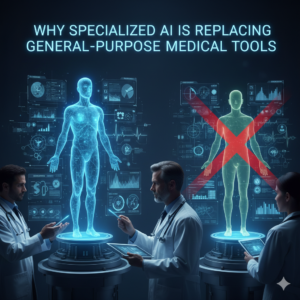
Unlike their predecessors, AI in healthcare specialized solutions 2026 understand the intricate regulatory landscape and the high-stakes environment of an ICU or surgical suite.
Specialization allows for better integration. For instance, an AI designed specifically for radiology can distinguish between benign and malignant tissue with a degree of sensitivity that general computer vision models simply cannot match. If you’re looking for verified software in this niche, our AI Tools Directory provides a filtered view of the best-performing clinical assets today.
How to Assess Your Healthcare Organization’s Readiness
Implementation is not just about purchasing a license; it’s about infrastructure. Before adopting AI in healthcare specialized solutions 2026, hospitals must undergo a rigorous audit. Are your servers capable of processing real-time genomic sequences? Is your staff trained to interpret algorithmic probability scores?
| Infrastructure Layer | 2026 Standard | Action Required |
|---|---|---|
| Data Processing | Edge Computing | Minimize latency for real-time alerts |
| Security Framework | Zero Trust Architecture | Protect AI in healthcare specialized solutions 2026 datasets |
AI and the Rise of Precision Medicine
Precision medicine is perhaps the most ambitious goal of AI in healthcare specialized solutions 2026. By combining genetic data with lifestyle factors and real-time biometric monitoring, AI can suggest treatments tailored to the individual rather than the average patient. This “N-of-1” approach is drastically reducing side effects and increasing the efficacy of complex chemotherapy regimens and biological therapies.
Overcoming Implementation Challenges in 2026
Despite the obvious benefits, deploying AI in healthcare specialized solutions 2026 comes with hurdles. Interoperability remains a primary concern; many legacy systems do not “speak” the same language as modern AI. To solve this, organizations are turning to FHIR (Fast Healthcare Interoperability Resources) standards to ensure seamless data exchange across different platforms and medical departments. Training clinicians to trust but verify AI outputs is equally critical to long-term success.
Step-by-Step: Implementing Specialized AI Workflows
The most successful deployments follow a phased approach. Start with Natural Language Processing (NLP) to reduce documentation burden. Modern AI scribes can now capture complex medical terminology and automatically code it into ICD-11 standards, saving physicians up to three hours per shift. Following documentation, the focus shifts to predictive imaging, where AI in healthcare specialized solutions 2026 lead to a 25% increase in early-stage detection rates.
Ethics, Compliance, and Data Sovereignty
As we move deeper into 2026, the ethical use of data has become paramount. AI in healthcare specialized solutions 2026 must operate within the strict boundaries of FDA and HIPAA frameworks. This ensures that algorithmic bias is monitored and patient privacy is protected through advanced anonymization protocols. Transparency is not optional; it is the foundation of patient trust.
Measuring ROI: Efficiency vs. Patient Outcomes
While financial ROI is important—most systems pay for themselves within 24 months—the true metric of success is the “Triple Aim”: improving the patient experience, enhancing population health, and reducing the cost of care. Deploying AI in healthcare specialized solutions 2026 achieves this by optimizing resource allocation, preventing readmissions, and identifying high-risk patients before acute events occur.