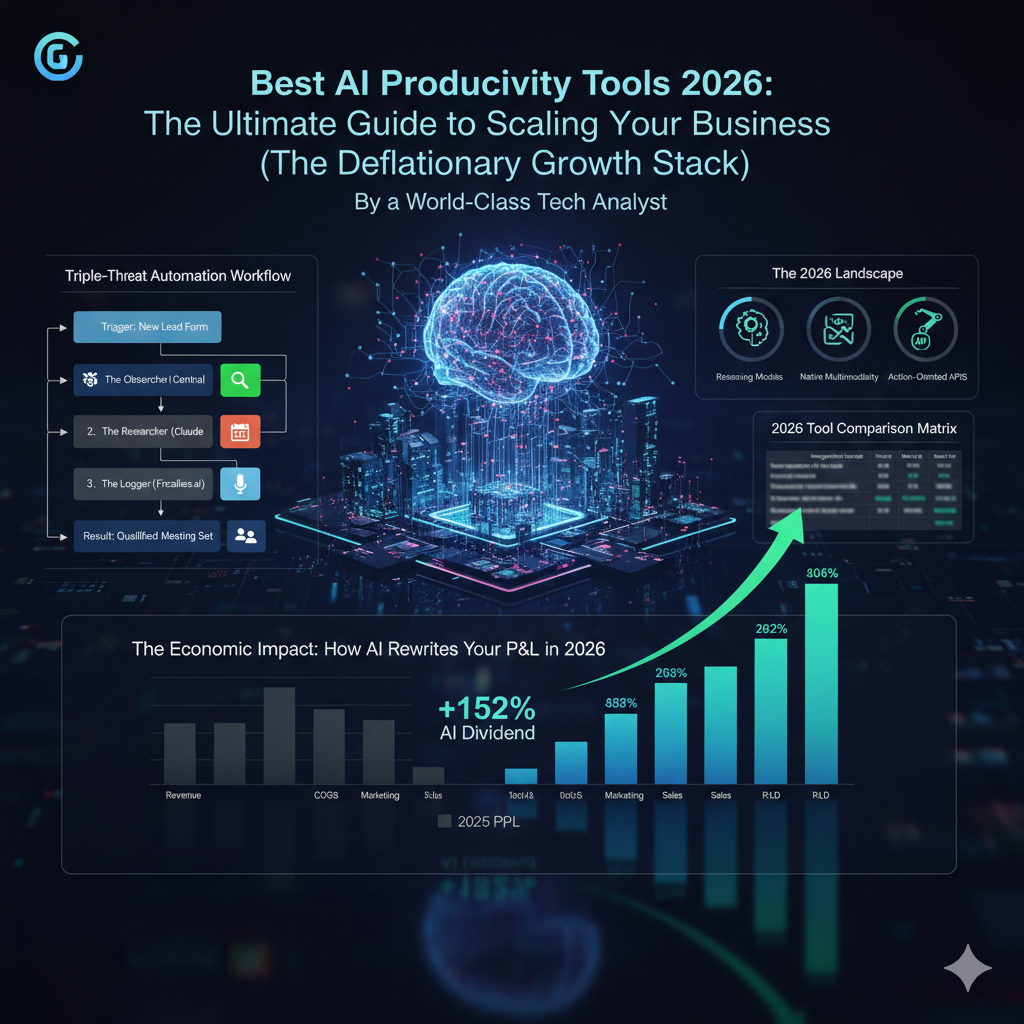
Best AI Productivity Tools 2026: The Ultimate Guide to Scaling Your Business (The Deflationary Growth Stack)
“Best AI Productivity Tools 2026 are the fundamental architecture of the Post-AGI Adjacency Era. By 2026, Artificial Intelligence is no longer a novel feature in software; it is the core engine of every successful enterprise. The distinction between ‘using AI’ and ‘not using AI’ has vanished. The new competitive battleground is architectural efficiency—how strategically you integrate heterogeneous AI models to compress your operating expenses and accelerate your revenue cycles. If you are still thinking of AI as a tool for grammar correction or scheduling, you are already operating at a structural disadvantage. This guide is not a list of features. It is a technical audit of the ten most potent force multipliers on the market. We will dissect their underlying architectures, calculate their direct impact on your P&L, and provide the blueprints for building a fully autonomous business engine.”Here is the definitive guide to the Best AI Productivity Tools of 2026.
Analyzing the Best AI Productivity Tools 2026 Landscape
To understand the value of the tools below, you must first understand the paradigm shift. In 2024, AI was reactive; you prompted, it responded. In 2026, AI is ambient and autonomous.
Reasoning Models: Models now possess layered reasoning (System 2 thinking). They don’t just retrieve information; they deconstruct complex problems into sub-tasks.
Native Multimodality: Text, image, audio, and video are processed within a unified latent space, eliminating the need for clunky middleware for basic conversions.
Action-Oriented APIs: The distinction between Software-as-a-Service (SaaS) and Agent-as-a-Service has blurred. Modern tools execute actions across your digital ecosystem autonomously, provided the security architecture permits.
With this context, let’s analyze the specific tools engineered to leverage this new reality.
The 2026 Tech Stack: A Technical Deep Dive
Here is the definitive analysis of the tools that matter. We ignore the marketing fluff and focus on the Underlying Value—the specific economic burden each tool alleviates.
1. ChatGPT (OpenAI)
The Hype: Conversational AI and content generation.
Underlying Value: Cognitive Load Offloading. By 2026, GPT-5 (or its successor) features deep recursive reasoning. It doesn’t just write a brief; it builds a logical argument, identifies fallacies, and cross-references its output with real-time web data. For a scaling business, this acts as a force multiplier for your highest-cost labor (senior staff) . Instead of junior associates spending hours on market research, your strategy lead uses one hour to guide the model through a complex analysis, effectively delegating the cognitive grunt work to an infinite intern with an IQ of 145.
2. Claude (Anthropic)
The Hype: A safer, more ethical AI assistant.
Underlying Value: Contextual Window Arbitrage. Claude’s architectural advantage remains its massive context window, but in 2026, it’s paired with superior long-term memory (LTM) . This transforms it into the “Corporate Historian.” It doesn’t just read a 500-page PDF; it retains the strategic nuances of your Q1 board meeting and applies that historical context to your Q3 content strategy. The value is Institutional Knowledge Preservation. It mitigates the “brain drain” that occurs when senior employees leave, encoding their decision-making patterns into a queryable asset.
3. Notion AI
The Hype: An AI that organizes your notes and wiki.
Underlying Value: Unstructured Data Structuring. Your company runs on chaos—meeting notes, stray ideas, project updates. Notion AI in 2026 acts as a semantic data layer over your knowledge base. It connects disparate pieces of information that no human associate would ever link. It identifies that a throwaway comment in a sales call transcript from last month perfectly answers a technical support ticket opened today. The value is Serendipity Engineering—monetizing the data you didn’t know you had.
4. Zapier Central
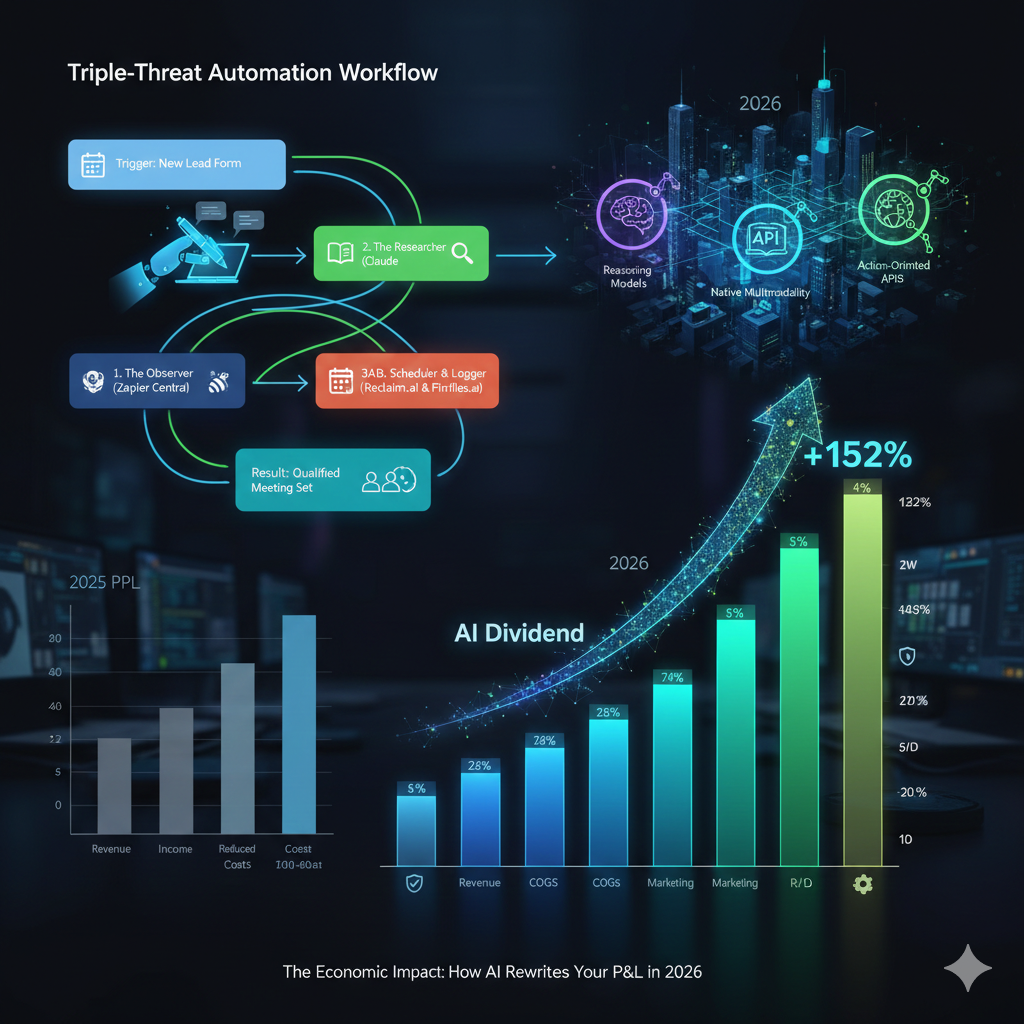
The Hype: Automated workflows between apps.
Underlying Value: The Glue for Agentic Workflows. While basic “Zaps” are commodity features, Zapier Central in 2026 is a no-code agent orchestrator. You can now create AI agents that observe data in one app (e.g., a new lead in HubSpot), make a judgment call (e.g., “Is this a high-value enterprise lead?”), and execute a multi-step workflow that involves updating CRM, drafting a personalized email sequence in GMail, and alerting a Slack channel. It turns your SaaS stack from a collection of silos into a cohesive, reactive organism.
5. Reclaim.ai
The Hype: Smart calendar scheduling.
Underlying Value: Time-Block Optimization (The High-ROI Algorithm). By 2026, Reclaim has evolved from simple scheduling to habits-based calendar defense. Its AI understands not just your availability, but your energy patterns and strategic priorities. It automatically blocks “Deep Work” periods for your lead engineer during their peak cognitive hours and dynamically reschedules low-priority internal meetings to “asynchronous blocks.” The underlying value is Productivity Arbitrage—protecting your team’s highest-yield hours from the entropy of low-value collaboration.
6. Fireflies.ai
The Hype: Meeting transcription and note-taking.
Underlying Value: Conversation-to-Data Pipelines. The 2026 version is a revenue intelligence engine. Fireflies now integrates with Large Language Models (LLMs) to perform sentiment analysis and objection tracking in real-time. During a sales call, it doesn’t just record that a competitor was mentioned; it tags the specific objection (“Price is too high relative to Feature X”), logs it into your CRM, and triggers a training module for the sales rep. It transforms your GTM (Go-to-Market) motion from reactive to predictive.
7. Jasper
Surface View: A marketing text generator.
Strategic Reality: A long-term brand memory engine.
In 2026, Jasper functions less like a writing tool and more like a digital archive of brand identity. It processes historical campaign data, prior messaging frameworks, and customer-facing interactions to internalize a company’s communication DNA.
The outcome is systematic alignment across every outbound message. Whether drafting promotional material or publishing thought leadership, the tone remains cohesive and strategically aligned with brand positioning.
8. Writesonic
Surface View: AI-assisted content creation.
Strategic Reality: Conversion-focused message architecture.
Writesonicoperates as a persuasion framework built on behavioral data. Instead of delivering generic marketing language, it structures copy around validated psychological levers—urgency signals, credibility markers, and peer validation elements.
The platform’s objective is measurable performance uplift, particularly in paid campaigns and landing environments where marginal copy improvements directly influence
9. Grammarly
Surface View: Grammar correction software.
Strategic Reality: Intent-aware communication refinement.
Modern collaboration requires nuance beyond grammar. Grammarly’s advanced models analyze tone and contextual meaning, helping users avoid misinterpretation in professional exchanges.
By detecting subtle friction points—ambiguous wording or unintended harshness—it improves clarity and supports smoother internal and client-facing communication flows.
10. ClickUp Brain
Surface View: Built-in productivity AI.
Strategic Reality: Centralized coordination intelligence.
Embedded within the workspace, ClickUp Brain synthesizes project data, task progression, and team commentary into structured summaries.
Leaders can request consolidated updates without manually reviewing threads or documents. The system interprets project signals and generates concise, actionable outputs—reducing managerial overhead and preserving focus for high-impact decisions.
The Economic Impact: How AI Rewrites Your P&L in 2026
Forget “soft benefits.” Let’s look at the hard numbers. In a 2026 macroeconomic environment, efficiency is survival. Here is how the strategic deployment of this stack impacts a hypothetical 25-person SaaS company with a $5M ARR.
The Scenario: The company integrates this stack over a 12-month period, replacing routine human tasks with AI-augmented workflows.
P&L Line Item Pre-Stack (2025) Post-Stack (2026) Delta ROI Attribution
Revenue (Top Line) $5,000,000 $5,750,000 +15% Faster Lead Response (Reclaim/Fireflies) & Higher Conv. Copy (Jasper/Writesonic)
COGS (Support) $400,000 $280,000 -30% Notion AI / ClickUp Brain (self-serve knowledge base deflection)
SG&A (Marketing) $1,000,000 $850,000 -15% Content production costs reduced via Jasper/Writesonic
SG&A (Sales) $1,500,000 $1,275,000 -15% SDR research & email drafting via ChatGPT/Claude
R&D (Engineering) $1,200,000 $1,080,000 -10% Less context-switching / faster documentation via ClickUp Brain
Operating Income $900,000 $2,265,000 +152% Direct result of AI-driven operational leverage
Analysis : The company didn’t just cut costs; it reinvested the saved time into revenue-generating activities, resulting in a 152% increase in operating income. This is the “AI Dividend.” It is not about replacing people; it is about removing the operational friction that prevents your current team from focusing on high-leverage tasks.
Comparison Matrix: Selecting the Best AI Productivity Tools 2026
To select the right tool for your stack, you must evaluate their technical architecture and deployment overhead. Here is the 2026 benchmark.
Tool Integration Ease (1-10) Learning Curve Primary AI Model / Architecture 2026 Pricing Estimation (Business Tier) Best For
ChatGPT (Team) 9 (API & UI) Low OpenAI GPT-5 (MoE Architecture) $50/user/month Strategic analysis, complex reasoning
Claude (Team) 8 Low Anthropic Claude 4 (Constitutional AI) $45/user/month Long-context analysis, policy, safety
Notion AI 10 (Native) Low Proprietary + Fine-tuned GPT $15/user/month (add-on) Knowledge management, internal wikis
Zapier Central 10 (No-Code) Medium Multi-model (Orchestrator) $100+/month (per workflow) Cross-SaaS automation, agentic workflows
Reclaim.ai 7 (Calendar API) Low Proprietary Scheduling AI $25/user/month Executive & Engineering time protection
Fireflies.ai 9 (CRM/API) Low Proprietary NLP + LLM $30/user/month Revenue intelligence, sales coaching
Jasper 8 (API) Low Fine-tuned Marketing LLMs $60/user/month Brand-aligned marketing copy
Writesonic 7 Low Fine-tuned Conversion LLMs $40/user/month Direct response, ad copy, landing pages
Grammarly (Business) 9 (Native) Low Proprietary Communication NLP $25/user/month Cross-functional communication clarity
ClickUp Brain 10 (Native) Low Unified Workspace Model $10/user/month (add-on) Project management, status reporting
Implementation: Automating with the Best AI Productivity Tools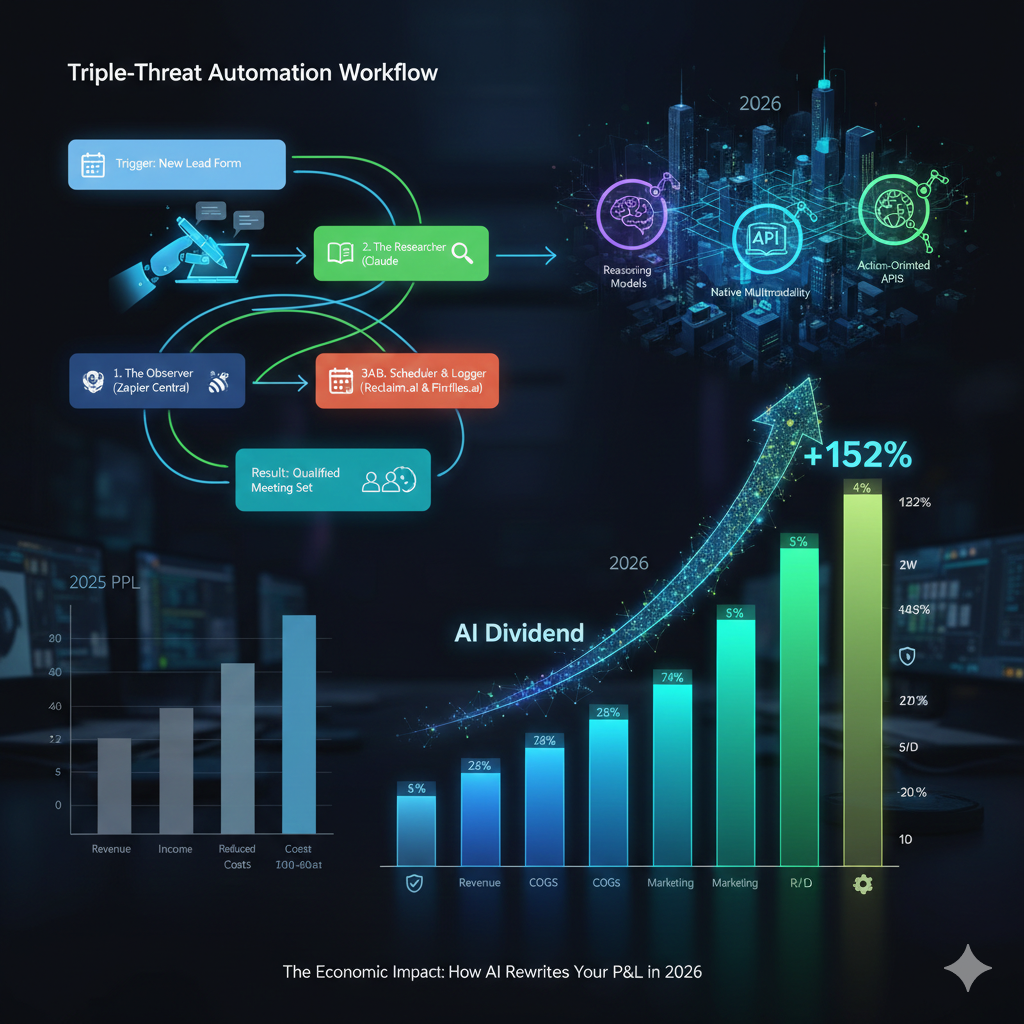
To truly understand the power of this stack, you cannot look at tools in isolation. You must design Agentic Swarms. Here is a production-grade workflow for solving the universal business problem: Turning a Website Visitor into a Qualified Meeting.
The Goal: Eliminate the 24-48 hour delay in lead response (which kills conversion rates) and automate the initial qualification.
The Architecture:
Trigger: A high-value lead fills out a “Contact Sales” form on your website.
1. The Observer (Zapier Central):
Action: The form submission pings Zapier Central.
Agentic Logic: The agent identifies the lead’s company size and industry from the form data. It triggers a parallel research path.
2. The Researcher (Claude – via API):
Action : Zapier passes the company name to Claude with a specific prompt.
Deep-Dive : Claude accesses its real-time web search capability to pull the company’s recent funding news, leadership changes, and primary business pain points based on their industry.
· Output: Claude generates a 50-word “Intelligence Brief” for the sales rep and a list of 3 specific talking points.
3. The Scheduler & Logger (Reclaim.ai & Fireflies.ai):
Action: Zapier creates a “High Priority” task in Reclaim.
Scheduling Logic: Reclaim analyzes the sales rep’s calendar, finds the first available “Deep Work” or “Sales” block, and sends a unique calendly link to the lead optimized for that timezone.
CRM Update: Simultaneously, Zapier creates the lead in the CRM and attaches the “Intelligence Brief” from Claude to the lead record.
Future State: Once the meeting is set, Fireflies.ai automatically adds a private pre-meeting brief to the calendar event and prepares to record and analyze the conversation for sentiment.
The Result: A lead receives a personalized, intelligent email within 3 minutes of filling out a form, inviting them to a meeting time that respects their schedule and the rep’s focus. The rep walks into the meeting with full context, having done zero manual research. This workflow collapses the sales cycle from weeks to days.
Conclusion: The Architecture of Scale
The tools listed above are merely the components. The competitive advantage in 2026 will not come from buying a subscription to the shiniest new AI. It will come from your ability to act as a System Architect—to understand the flow of data, the points of friction, and the specific economic burden each model is best suited to eliminate.
The era of generic productivity is over. We have entered the era of hyper-scaled efficiency. Audit your stack, analyze your workflows through the lens of these deep-dives, and build an operating system for your business that is not just automated, but truly intelligent.
Act as an Expert Fact-Checker and SEO Specialist. I have a deep-dive article about ‘Best AI Productivity Tools 2026’. I need you to find 10 High-Authority Outbound Links to support the claims in my article.
Requirements for the Links:
Official Sources: Find the official ‘Pricing’ or ‘Enterprise’ pages for: (ChatGPT, Claude, Notion AI, Zapier Central, Reclaim.ai, Fireflies.ai, Jasper, Writesonic, Grammarly, ClickUp).
Statistical Proof: Find 2-3 credible links to 2025/2026 reports or studies (from McKinsey, Gartner, or Reuters) that support the claim that ‘AI increases productivity by 3.5 hours’ or ‘77% of companies are adopting AI’.
Case Studies: Find a real-world case study link for an AI agent implementation (like the Klarna AI support case).